Introduction
Choosing the right material is one of the most important decisions when planning a commercial or institutional restroom.
A Toilet Cubicle Partition needs to provide privacy while also withstanding moisture, frequent cleaning, repeated use, and everyday physical contact. The appropriate material can also influence the appearance, maintenance requirements, durability, and overall value of the restroom installation.
There is no single material that is ideal for every facility.
An office restroom may have different requirements from a school, hotel, hospital, shopping centre, airport, restaurant, or factory. Factors such as expected traffic, humidity, cleaning frequency, design preferences, budget, and installation conditions should therefore be considered before selecting a partition material.
Common options include compact laminate, HPL-based panels, HDPE or solid plastic, stainless steel, and other purpose-designed partition materials.
This guide explains the major options and the factors businesses should consider when choosing a Toilet Cubicle Partition material.
Team Interior Solution provides restroom and interior solutions for commercial and institutional applications, with attention to practical design, functionality, appearance, and project-specific requirements.
Why Does Toilet Cubicle Material Matter?
The partition material is directly exposed to the restroom environment.
Depending on the facility, panels may encounter:
- Water splashes
- High humidity
- Frequent cleaning
- Cleaning chemicals
- Repeated physical contact
- Accidental impacts
- Scratches
- Continuous daily use
Material selection can therefore affect the long-term performance of the cubicle.
A suitable material should provide the characteristics required for the specific application rather than simply looking attractive or being inexpensive.
Important properties to evaluate include:
- Moisture resistance
- Durability
- Impact resistance
- Surface finish
- Ease of cleaning
- Maintenance requirements
- Appearance
- Installation requirements
- Expected service conditions
1. Compact Laminate
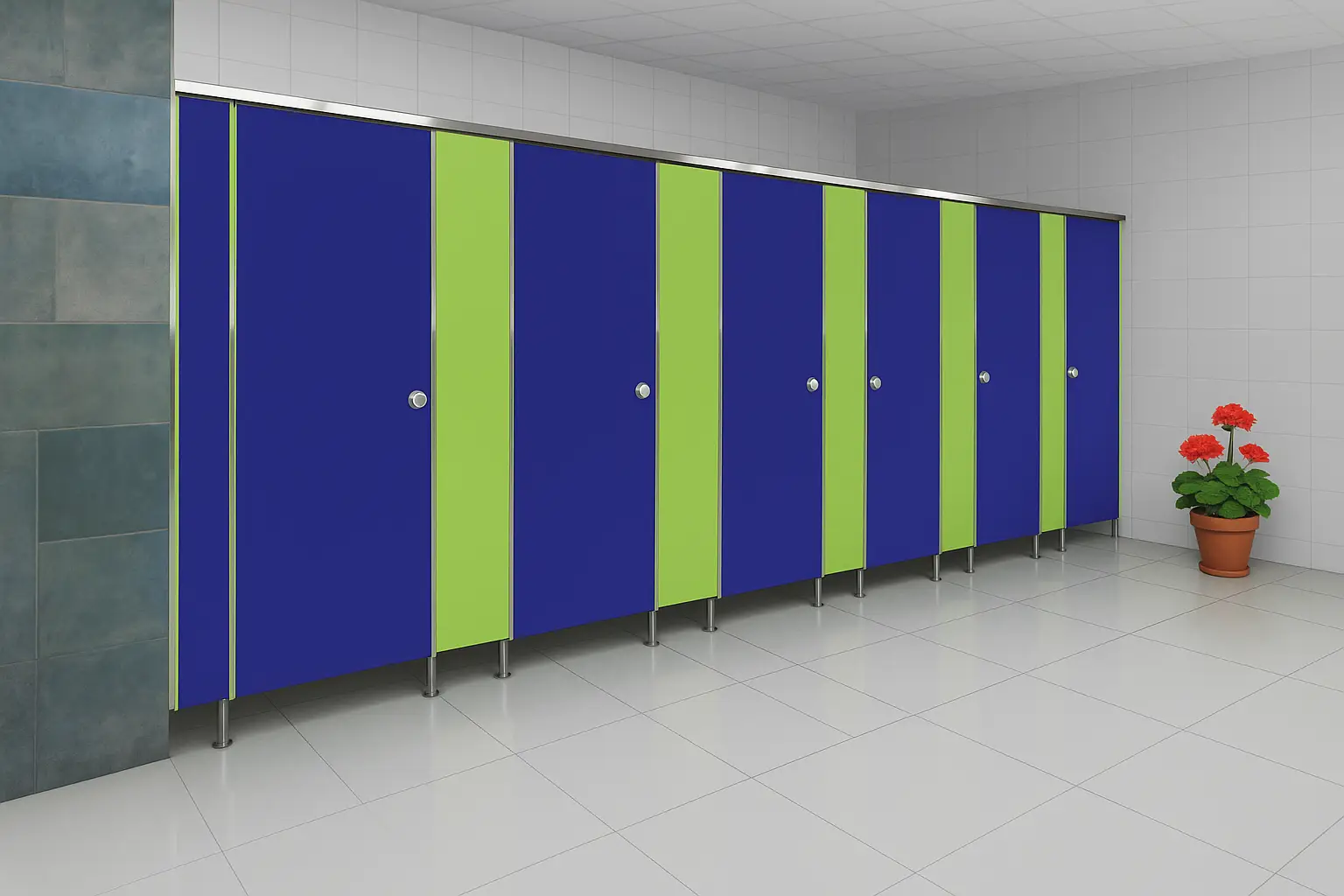
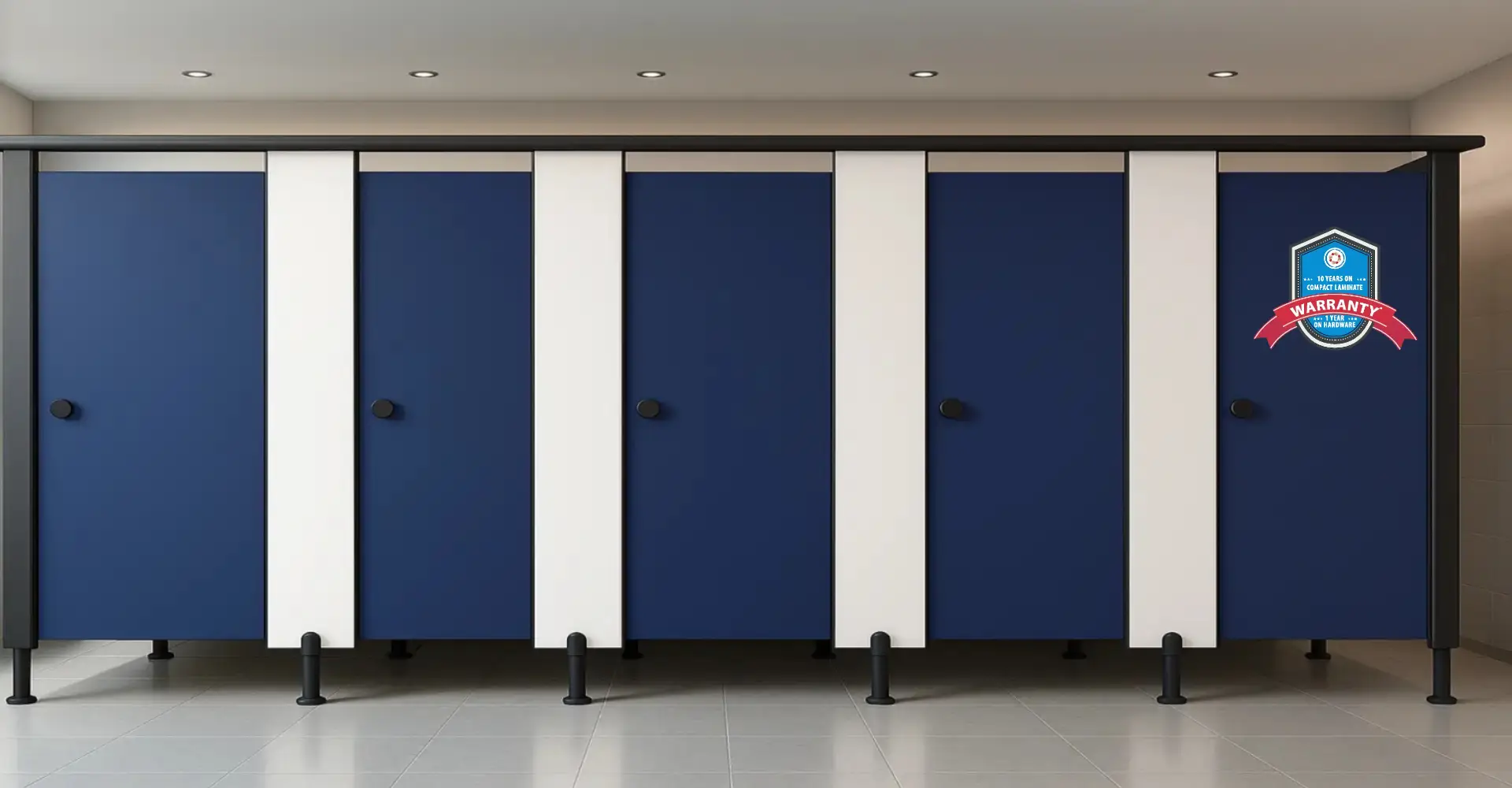
Compact laminate is one of the widely considered materials for commercial toilet cubicles.
It is made by compressing multiple layers of resin-impregnated paper under high pressure to create a dense, rigid panel.
Its dense construction can provide useful properties for restroom applications, including resistance to moisture and everyday wear.
Compact laminate can be suitable for facilities such as:
- Offices
- Hotels
- Shopping centres
- Schools
- Hospitals
- Restaurants
- Airports
- Commercial buildings
It is also available in a variety of colours and surface finishes, allowing designers to coordinate partitions with the overall restroom interior.
Key advantages
- Durable construction
- Good moisture resistance
- Available in different finishes
- Easy-to-clean surface options
- Suitable for commercial applications
- Professional appearance
The exact performance depends on the product specification and installation system.
2. HPL-Based Toilet Cubicle Panels
High-pressure laminate, or HPL, can also be used as part of restroom partition systems.
HPL provides a decorative and durable surface that can be used with an appropriate core or panel construction.
When evaluating an HPL toilet cubicle, buyers should distinguish between the decorative surface and the underlying panel construction.
Important questions include:
- What is the panel core?
- Is the panel suitable for wet environments?
- What is the panel thickness?
- How are the edges finished?
- What cleaning products are recommended?
- What hardware is supplied?
HPL-based solutions can provide considerable flexibility in colour, pattern, and finish, making them useful when restroom appearance is an important consideration.
3. HDPE and Solid Plastic Panels
HDPE, or high-density polyethylene, is another option for toilet cubicle partitions.
Solid plastic panels can be considered for environments where moisture resistance and practical maintenance are important.
Because the material is not dependent on conventional wood-based construction, it can be useful in wet restroom environments.
Potential applications include:
- Schools
- Public restrooms
- Sports facilities
- Recreational centres
- Commercial washrooms
- High-use institutional facilities
Key advantages
- Moisture resistant
- Easy to clean
- Durable
- Suitable for wet environments
- Available in different colours
The suitability of a specific HDPE product depends on its grade, thickness, hardware, and intended application.
4. Stainless Steel
Stainless steel toilet partitions are another option, particularly for facilities that prioritise durability, hygiene, and a robust appearance.
Stainless steel can provide a strong and easily cleanable surface when appropriately specified.
It may be considered for:
- Airports
- Hospitals
- Public facilities
- Transportation facilities
- High-traffic commercial restrooms
- Industrial environments
Key advantages
- Strong construction
- Professional appearance
- Easy-to-clean surface
- Good resistance to corrosion when the appropriate grade is selected
- Suitable for demanding applications
However, stainless steel can have a different cost and appearance from plastic or laminate-based systems.
The appropriate stainless-steel grade should also be selected according to the environmental conditions.
5. Solid Phenolic Panels
Solid phenolic panels are closely related to compact laminate systems and are commonly used for restroom applications requiring durable, moisture-resistant panels.
They are manufactured from resin-impregnated paper layers compressed under heat and pressure.
Their dense construction makes them suitable for wet-area applications where conventional moisture-sensitive board products may be less appropriate.
They can offer:
- High durability
- Moisture resistance
- Impact resistance
- Easy maintenance
- Different colour and finish choices
The exact specification should be checked with the manufacturer or supplier before purchasing.
6. PVC and Other Plastic-Based Options
Some restroom partition systems use PVC or other plastic-based materials.
These can provide a lightweight and practical solution for certain applications.
However, buyers should not assume that all plastic panels have the same performance.
When comparing products, check:
- Plastic type
- Panel thickness
- Rigidity
- Impact resistance
- Surface quality
- Moisture performance
- Hardware compatibility
- Manufacturer specifications
The material should be selected according to the expected use rather than simply being classified as “plastic.”
Material Comparison at a Glance
| Material | Moisture Resistance | Durability | Maintenance | Appearance Options | Common Applications |
|---|---|---|---|---|---|
| Compact Laminate | High | High | Easy | Wide | Commercial and institutional |
| HPL-Based Panels | Depends on construction | Good | Easy | Wide | Offices, commercial spaces |
| HDPE/Solid Plastic | High | Good to High | Easy | Multiple options | Schools, public facilities |
| Stainless Steel | High with suitable grade | High | Easy | Limited but distinctive | High-traffic facilities |
| Solid Phenolic | High | High | Easy | Multiple options | Commercial and institutional |
| PVC/Plastic Options | Product dependent | Product dependent | Generally easy | Multiple options | Selected applications |
This table provides a general comparison. Actual performance depends on the specific product, panel construction, thickness, hardware, installation, and environmental conditions.
Which Material Is Best for High-Traffic Restrooms?
High-traffic facilities need materials and hardware that can handle frequent use.
Examples include:
- Shopping centres
- Airports
- Railway facilities
- Schools
- Stadiums
- Public buildings
- Large offices
Compact laminate, solid phenolic, stainless steel, and durable solid-plastic systems can all be considered depending on the specific requirements.
The decision should not be based on material name alone.
Panel thickness, hardware quality, support design, installation, and maintenance all influence the final performance of a Toilet Cubicle Partition.
Which Material Is Suitable for Wet Environments?
For restrooms with significant moisture exposure, buyers should prioritise materials designed to handle wet conditions.
Compact laminate, solid phenolic, and suitable solid-plastic systems can be considered for such applications.
Stainless steel can also be suitable when the appropriate grade is selected and the installation is designed correctly.
The important point is to evaluate the complete product specification rather than assuming that any material will automatically perform well in a wet environment.
Material Choice for Schools
Schools often require restroom partitions that can withstand frequent use and regular cleaning.
Durability, ease of maintenance, privacy, and reliable hardware may be important considerations.
Solid plastic and compact laminate solutions can be evaluated depending on the school’s requirements and budget.
The partition system should also be planned around student safety, supervision requirements, accessibility, and applicable standards.
Material Choice for Hotels
Hotels may place greater emphasis on appearance and finish quality while still requiring durability and easy maintenance.
Compact laminate and HPL-based solutions can provide design flexibility through different colours and surface finishes.
For hotel projects, buyers should consider how the cubicle finish coordinates with the overall interior design.
Material Choice for Hospitals
Healthcare facilities may have additional requirements related to hygiene, cleaning, accessibility, durability, and moisture.
The selected material should be compatible with the cleaning and sanitation procedures followed by the facility.
Smooth, easily cleanable surfaces and suitable hardware can be important considerations.
Project teams should also review applicable healthcare and accessibility requirements before finalising the specification.
Material Choice for Offices
Office restrooms often require a balance between:
- Professional appearance
- Privacy
- Durability
- Maintenance
- Cost
HPL and compact laminate solutions can offer design flexibility while providing practical performance for many office environments.
The final choice should reflect the expected traffic and restroom design.
Why Hardware Matters as Much as the Material
When selecting a toilet cubicle, it is easy to focus entirely on the panel.
However, the hardware is equally important to everyday operation.
Hinges, locks, brackets, handles, and support components experience repeated use.
For example, a durable panel does not prevent a door from becoming difficult to operate if its hinges are poorly selected or incorrectly installed.
This is why businesses should compare the complete Toilet Cubicle Partition system, including both panels and hardware.
Which Material Is Best for High-Traffic Restrooms?
High-traffic facilities need materials and hardware that can handle frequent use.
Examples include:
- Shopping centres
- Airports
- Railway facilities
- Schools
- Stadiums
- Public buildings
- Large offices
Compact laminate, solid phenolic, stainless steel, and durable solid-plastic systems can all be considered depending on the specific requirements.
The decision should not be based on material name alone.
Panel thickness, hardware quality, support design, installation, and maintenance all influence the final performance of a Toilet Cubicle Partition.
Which Material Is Suitable for Wet Environments?
For restrooms with significant moisture exposure, buyers should prioritise materials designed to handle wet conditions.
Compact laminate, solid phenolic, and suitable solid-plastic systems can be considered for such applications.
Stainless steel can also be suitable when the appropriate grade is selected and the installation is designed correctly.
The important point is to evaluate the complete product specification rather than assuming that any material will automatically perform well in a wet environment.
Material Choice for Schools
Schools often require restroom partitions that can withstand frequent use and regular cleaning.
Durability, ease of maintenance, privacy, and reliable hardware may be important considerations.
Solid plastic and compact laminate solutions can be evaluated depending on the school’s requirements and budget.
The partition system should also be planned around student safety, supervision requirements, accessibility, and applicable standards.
Material Choice for Hotels
Hotels may place greater emphasis on appearance and finish quality while still requiring durability and easy maintenance.
Compact laminate and HPL-based solutions can provide design flexibility through different colours and surface finishes.
For hotel projects, buyers should consider how the cubicle finish coordinates with the overall interior design.
Material Choice for Hospitals
Healthcare facilities may have additional requirements related to hygiene, cleaning, accessibility, durability, and moisture.
The selected material should be compatible with the cleaning and sanitation procedures followed by the facility.
Smooth, easily cleanable surfaces and suitable hardware can be important considerations.
Project teams should also review applicable healthcare and accessibility requirements before finalising the specification.
Material Choice for Offices
Office restrooms often require a balance between:
- Professional appearance
- Privacy
- Durability
- Maintenance
- Cost
HPL and compact laminate solutions can offer design flexibility while providing practical performance for many office environments.
The final choice should reflect the expected traffic and restroom design.
Why Hardware Matters as Much as the Material
When selecting a toilet cubicle, it is easy to focus entirely on the panel.
However, the hardware is equally important to everyday operation.
Hinges, locks, brackets, handles, and support components experience repeated use.
For example, a durable panel does not prevent a door from becoming difficult to operate if its hinges are poorly selected or incorrectly installed.
This is why businesses should compare the complete Toilet Cubicle Partition system, including both panels and hardware.
Conclusion
The material used for a Toilet Cubicle Partition can influence its durability, moisture resistance, maintenance, appearance, and suitability for different restroom environments.
Compact laminate is a popular option for commercial applications where durability, moisture resistance, and design flexibility are important. HPL-based systems can offer a range of decorative finishes, while solid plastic and HDPE can be considered for wet and frequently used environments. Stainless steel provides another option for projects that prioritise robust construction and a distinctive appearance.
However, there is no universal best material.
The right choice depends on the facility, expected traffic, moisture exposure, cleaning procedures, privacy requirements, design preferences, installation conditions, and budget.
Businesses should also evaluate the complete cubicle system. Panel material alone does not determine performance. Hardware, support structure, door design, locking mechanisms, fixing methods, and installation quality all contribute to the finished product.
For this reason, buyers should compare complete specifications rather than relying on price or appearance alone.
Team Interior Solution provides restroom and interior solutions for commercial and institutional applications, with attention to practical design and project-specific requirements.
By selecting a material that matches the actual conditions of the facility and evaluating the complete Toilet Cubicle Partition system, businesses can create restrooms that are practical, durable, easy to maintain, and visually suitable for their users.
Frequently Asked Questions
1. What materials are used for toilet cubicle partitions?
Common options include compact laminate, HPL-based panels, HDPE or solid plastic, stainless steel, solid phenolic panels, and other specialised partition materials.
2. Which material is best for a toilet cubicle partition?
There is no single best material for every facility. The choice should depend on moisture exposure, traffic, durability, cleaning requirements, appearance, installation conditions, and budget.
3. Is compact laminate suitable for commercial toilet cubicles?
Compact laminate can be suitable for many commercial and institutional restroom applications because it can provide a combination of durability, moisture resistance, and design flexibility.
4. Is HDPE suitable for wet restrooms?
HDPE and other solid-plastic systems can be considered for wet environments because they can provide good moisture resistance. The specific product specification should be checked before purchase.
5. Why is panel thickness important?
Panel thickness contributes to the stability and overall performance of the cubicle system. It should be selected according to the material, dimensions, support structure, hardware, and intended application.
6. Are stainless steel toilet partitions durable?
Stainless steel can provide durable performance for demanding restroom environments. The appropriate stainless-steel grade and installation method should be selected according to the environmental conditions.